
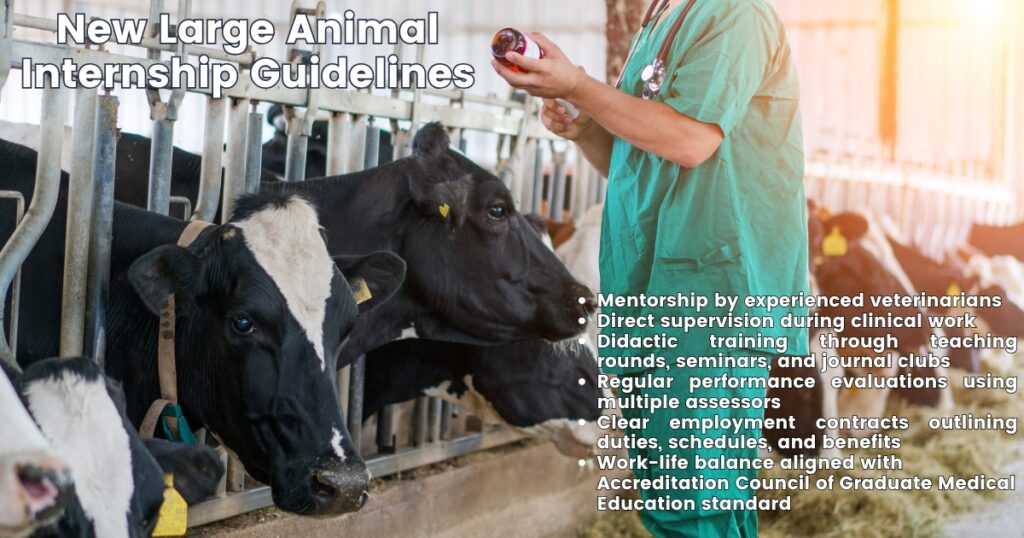
The American Veterinary Medical Association (AVMA) has introduced new guidelines specifically tailored for large animal veterinary internships, creating a comprehensive framework that emphasizes mentorship, supervision, and educational outcomes for early-career veterinarians.
For the first time, the AVMA now offers two distinct sets of guidelines: “Veterinary Large Animal Hospital Internship Guidelines” and “Veterinary Large Animal Ambulatory Internship Guidelines.” These new resources complement the organization’s existing “Veterinary Small Animal Internship Guidelines,” which was recently renamed to reflect its specific focus.
The new guidelines establish clear expectations for both internship providers and participants in large animal practice settings, addressing the unique aspects of this veterinary specialty that weren’t adequately covered in previous documents.
“During a recent review of AVMA’s internship guidelines by the Veterinary Specialty Organizations Committee, committee members agreed that the policy didn’t adequately account for issues unique to interning at a large animal practice, and particularly those performed in a primarily ambulatory setting,” the AVMA explained in its announcement.
Core Elements of the New Guidelines
The guidelines emphasize that internships should be one-year educational experiences focused on clinical training across multiple disciplines. Key components include:
Mentorship by experienced veterinarians
Direct supervision during clinical work
Didactic training through teaching rounds, seminars, and journal clubs
Regular performance evaluations using multiple assessors
Clear employment contracts outlining duties, schedules, and benefits
Work-life balance aligned with Accreditation Council of Graduate Medical Education standards
The guidelines explicitly state that “the primary purpose of internships is educational, not to simply provide labor for the hosting institution.” This crucial distinction helps protect new veterinarians from exploitation while ensuring they receive the training necessary for career advancement.
Clinical and Professional Development
For clinical development, the guidelines specify that interns should have opportunities to assume primary care responsibilities for diverse cases while under appropriate supervision. They must also be allowed to assist with surgeries and be granted increasing independence as they develop proficiency.
Importantly, the guidelines address ethical concerns by stating that “veterinary interns must not be the sole veterinarians at satellite sites,” ensuring proper oversight for patient care and intern education.
The AVMA Board of Directors approved these guidelines during a February conference call, alongside updates to the organization’s policy on “Guidelines on the Identification of Board-Certified Veterinarians.”
Measuring Success and Continuous Improvement
The guidelines encourage internship programs to implement quality assessment measures including:
Monitoring intern progression throughout the program
Collecting feedback from interns about their experiences
Tracking residency placement rates and other outcomes
Using collected data to continuously improve program quality
These new guidelines represent an important step in standardizing the educational experience for veterinarians pursuing careers in large animal medicine, whether in hospital or ambulatory settings.
The comprehensive approach ensures that early-career veterinarians receive appropriate mentorship and training while establishing reasonable expectations for all parties involved in the internship relationship.
References:
Source: https://www.avma.org/news/large-animal-internship-guidelines-emphasize-mentorship-supervision-outcomes