
When I was a kid, our family dog ate the edges of my mother’s beautiful living room drapes. Because she loved that dog more than her children, she blamed us for touching the drapes with sticky fingers. In her mind, the food residue on the drapes enticed the dog to eat them and thus, the dog, but not the children, were forgiven.
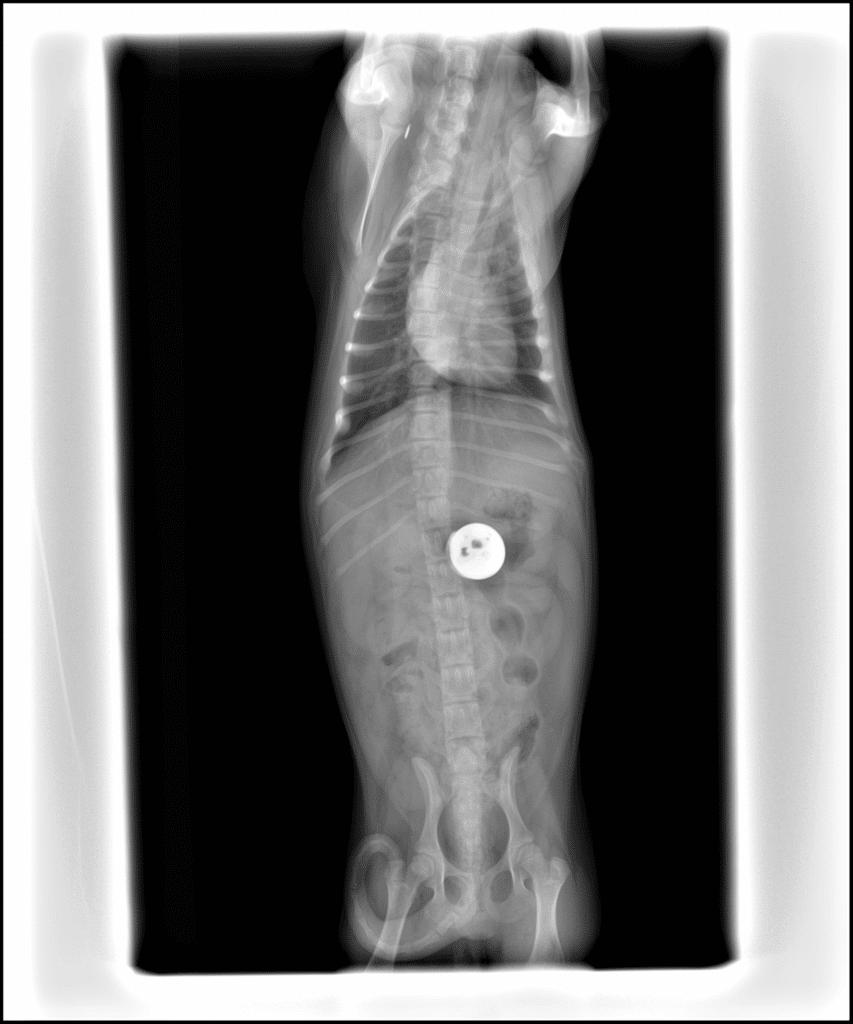
Fast forward to the present and, as a veterinarian at the Schwarzman Animal Medical Center, I routinely encounter patients who eat items with no nutritional value, a condition called “pica.” If you follow us on Facebook and Instagram, you’ve seen the dramatic x-rays of animals that have eaten items like a string of lights, an airtag, rocks, magnets, an ethernet cable and all manner of other non-food items. Today’s blog takes a closer look at pica—what it is, why it happens, and why it matters.
Puppies and Kittens Eating Non-food Items
Puppies and kittens explore their world with their mouths, so it’s not surprising for them to swallow a non-food item like a ball or a piece of string. For most pets, this is a one-time event that doesn’t become a habit.
More concerning are the pets who repeatedly eat non-food items, like the dog seen in AMC’s ER for the third time after eating a pile of coins left on the coffee table. Pets like that clearly have disordered eating, which is another way of defining pica.
Pets Licking Grout in the Bathroom
More than once, I have seen canine patients brought in for licking the grout between the bathroom wall tiles. One of the first diagnoses I consider in these patients is anemia, a condition where the body doesn’t have enough red blood cells. Veterinarians don’t know why, but anemic pets will display pica-like behaviors. They may lick tile grout, and anemic cats will also eat cat litter, which is visible on x-ray when we perform our diagnostic testing.
In people, pica associated with anemia can be related to iron deficiency. However, iron deficiency is very uncommon in dogs and cats, and my experience tells me it is a rare cause of pica in pets.
Pica and Intestinal Disease in Pets
A recent study published in the Journal of the American Veterinary Medical Association reports an association between foreign objects in the stomach and clinical signs of gastrointestinal disease. The authors suggest adult dogs and cats with clinical signs of vomiting, diarrhea, a gastric foreign body and multiple episodes of pica should have biopsies of the stomach and intestine when the foreign body is removed. This can help identify underlying inflammation or disease contributing to the behavior.
Pica Can Be Dangerous for Animals
Pica isn’t just a strange behavior that pets display—it can be dangerous. Any pet that swallows a non-food item larger than the diameter of their intestine is at risk for a life-threatening intestinal obstruction. Eating dirt carries the risk of ingesting intestinal parasites, such as hookworms, whipworms and roundworms. These parasites can be very hardy and survive for weeks in the environment, resistant to dry or freezing conditions.
Pet birds can fall victim to lead poisoning when they nibble on little bits of lead-based paint that have chipped off your woodwork or radiator.
Cats sometimes develop a behavior called “wool sucking,” where they chew or suck on fabric. It’s thought to be an expression separation anxiety when a kitten is taken away from their mother too early. While this behavior is typically more destructive to your wardrobe than dangerous to your pet, it’s worth monitoring just the same!
Helpful Hints For Pets with Pica
Prevent your dog from eating dirt and make sure to administer a monthly medication to prevent intestinal parasites.
Monitor puppies and kittens carefully to prevent the curious youngster from ingesting something dangerous.
See your veterinarian for a medical evaluation if your pet is regularly eating strange things.