
Medical professionals have special words for most conditions. One of those words is dystocia, which refers to a prolonged or difficult birth. In a previous blogpost, I wrote about one potential outcome of a difficult birth—Cesarean surgery.
It’s not uncommon for veterinarians at the Schwarzman animal Medical Center to treat dystocia in dogs and cats. However, today’s blogpost will detail dystocia in a less common patient than a dog or cat: a red-eared slider.
Causes of Dystocia
Difficulty giving birth has multiple possible causes.
Fetal Size or Position: The baby may simply be too big or poorly positioned to be delivered successfully.
Poor Maternal Nutrition: Mothers with a poor diet, especially those deficient in calcium, may not have a strong enough uterus to give birth. Veterinarians commonly give calcium and a hormone called oxytocin to improve uterine contractions in cases of dystocia.
Low Blood Sugar: A long labor can deplete blood glucose, resulting in weak contractions.
Abnormal Eggs: In egg-laying animals, eggs can be misshapen, lacking the smooth surface of a normal egg and making them difficult to pass.
Improper Environment: Exotic pets have unique husbandry considerations and often have dystocia when their environment isn’t sufficient to nest or lay eggs.
Diagnosing Dystocia
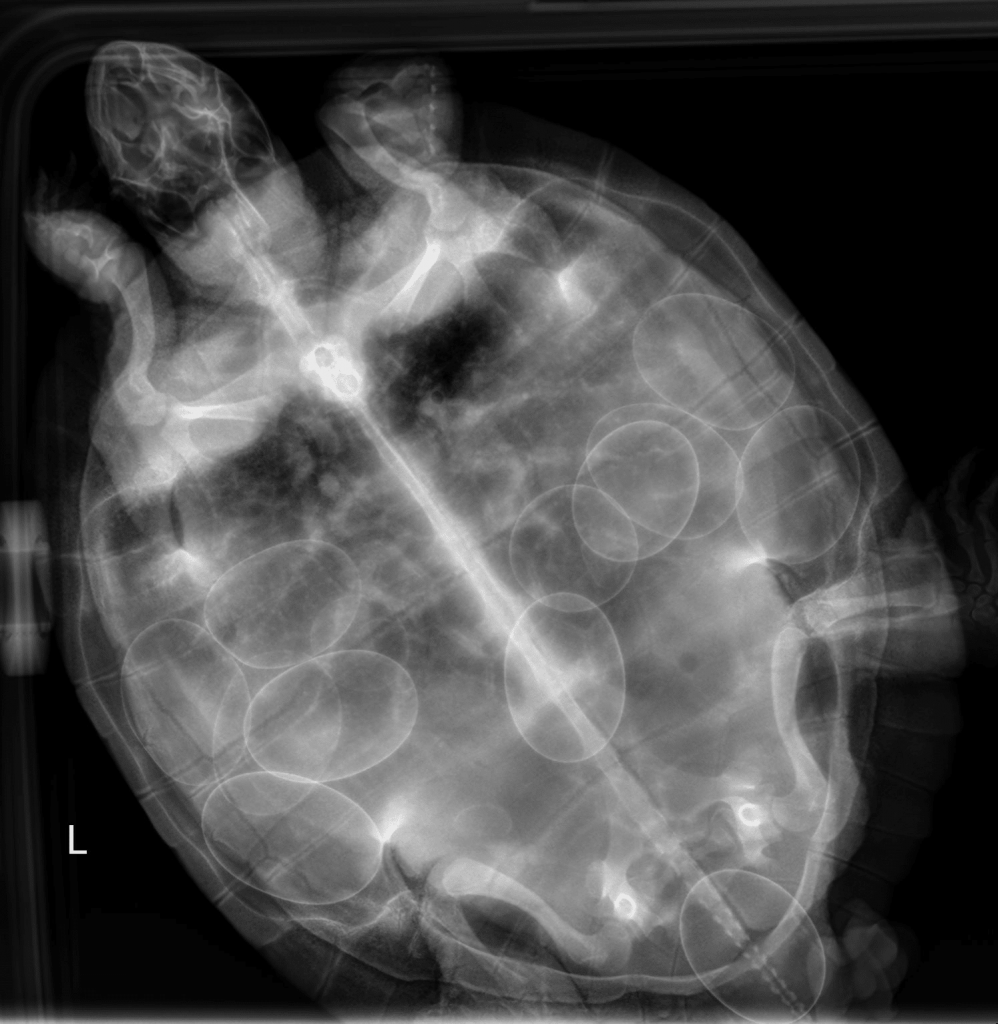
AMC’s Emergency Room veterinarians saw Shelly, a red eared slider whose owner noticed abnormal tissue protruding from her turtle’s hind end after Shelly had laid two eggs. This tissue turned out to be a prolapsed cloaca—another medical term referring to the end of the birth canal popping out while Shelly was straining to pass a stuck egg. This was a clear indication Shelly was having a great deal of difficulty passing eggs. The x-ray below shows an egg stuck half in and half out of Shelly and another twelve eggs needing to be laid!
Treating Dystocia
Just like a cat or dog with dystocia, Shelly received intravenous calcium, oxytocin and pain medication. AMC veterinarians lubricated the egg to facilitate delivery, but after 24 hours, there was no progress. Veterinarians on AMC’s Avian and Exotic Pet Service then performed a more advanced procedure. Since Shelly’s eggs were unfertilized (she did not have a mate), our team removed the contents of the stuck egg using a syringe and needle. Then they broke the egg’s shell and used forceps to gently extract the remains. Shelly’s cloaca was placed back into its normal position and sutured in place. Shelly was discharged with instructions for her owner to keep track of the number of eggs laid and to monitor for recurrence of the cloacal prolapse. A few days later, the owner reported multiple eggs had been laid successfully.
Resources for Pet Families with an Expectant Dog or Cat
If you have a dog or cat that is expecting, here are some tips for a successful delivery: