
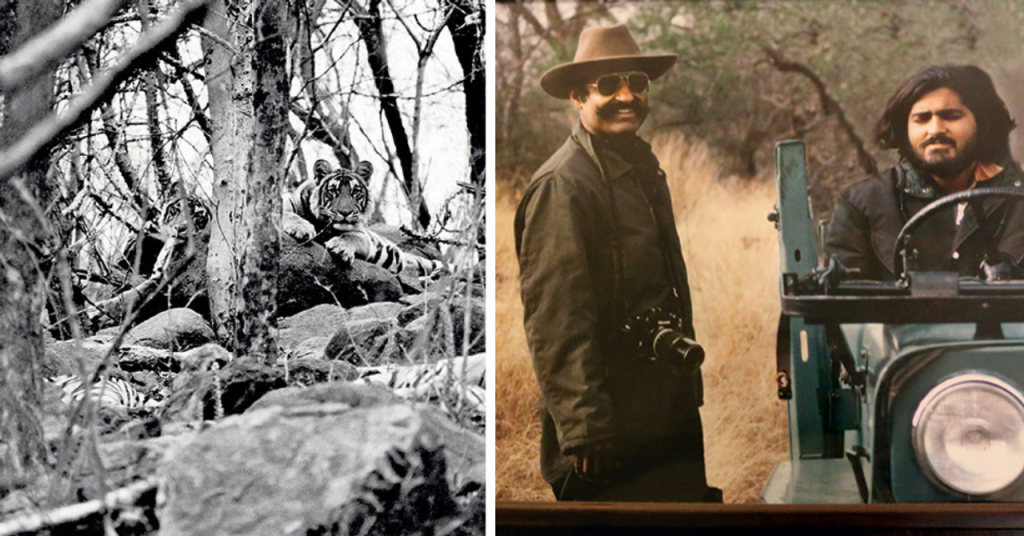
A documentary camera lingers on a tigress moving through dry grass, no rush in her stride.
For many, Legendary Tigers of India captures the beauty of the wild. For Valmik Thapar, whose voice carries the film, it draws from decades spent observing the Royal Bengal Tiger up close.
Thapar, who passed away in May last year, had arrived in Ranthambore in the early 1970s as someone looking to step away from the noise of Delhi. He was then a young filmmaker, not a conservationist.
Along the way, he found a landscape that was on the edge of being forgotten.
And then, he encountered a tigress who would anchor his life to this place.
The tigress who changed everything. She was called Padmini. Padmini raised cubs that would go on to shape Ranthambore’s tiger population. Her daughter, Noor, established dominance over fertile territories near the lakes.
Then, another tigress would come to define Ranthambore for the world: Machli.
Machli challenged her own mother for territory, raised generations, and became central to the identity of the park. Her genetic line continued through tigresses like Krishna and Arrowhead.
Machli was considered India’s most famous tigress and, before her death, the oldest living in the wild Photograph: (Wikipedia)
But even as these lives played out, many lives were being lost. This story of individual tigers unfolding in one forest mirrored a larger reality across the country. While some landscapes still held on, India’s overall tiger population was slipping towards a dangerous decline.
In 1973, India launched Project Tiger with just 1,827 tigers left in the wild. It began with the realisation that India was on the verge of losing its most powerful symbol.
When the tiger was almost lost
Centuries of hunting, first by colonial officers, then by royalty and elites, had turned the animal into a symbol of sport.
Firearms made killing efficient. Prestige made it desirable.
By the early 1970s, India’s wild tiger population had dropped to 1,827. It was a number that forced a reckoning.
Tigers at the Tadoba Andhari Tiger Reserve in Maharashtra. Photograph: (Deepak Kr)
In 1973, Project Tiger was launched as an urgent intervention. Led by Kailash Sankhala, India’s first director of Project Tiger and a pioneering conservationist, the programme set out to do something India had never attempted at this scale, protect an entire ecosystem by focusing on one species.
Nine reserves were identified in the beginning. The approach was to secure core habitats, limit human disturbance, and allow natural systems to rebuild.
The years that tested the system
Recovery, however, did not come in a straight line. By 2006, tiger numbers had dropped again — to 1,411. The decline exposed gaps like weak monitoring, organised poaching, and inflated data in some regions.
This moment became a turning point. Conservation efforts began to rely more on technology and transparency. Camera traps replaced older estimation methods, allowing individual tigers to be identified through their stripe patterns. Independent verification processes improved the credibility of data. At the same time, the National Tiger Conservation Authority (NTCA) was set up to strengthen oversight and ensure accountability across reserves.
The ripple effect of saving a tiger
Today, India is home to over 3,000 wild tigers.
From the original nine reserves, the network has expanded to 58, spanning diverse landscapes, from the mangroves of the Sundarbans to the forests of central India.
But the impact of Project Tiger extends far beyond the species it was named after. And the growth shows how protecting tigers helps entire forests recover.
When a tiger is protected, the forest around it is protected too. Tigers need large territories, clean water, and a healthy population of prey to survive. So when forests are secured for tigers, grasslands begin to regenerate, rivers and water sources stabilise, and animals like deer and wild boar increase in number. In turn, this supports birds, reptiles, and smaller mammals, creating a balanced and thriving ecosystem.
The human effort behind the comeback
What often goes unseen is the scale of human effort that sustains this recovery.
Forest guards patrol difficult terrain daily, often under threat from poachers. Local communities, in many cases, have adjusted their lives to coexist with wildlife.
And then there were storytellers like Valmik Thapar, who ensured that these efforts were not invisible.
53 years later…
On 1 April 2026, Project Tiger completed 53 years. The numbers suggest success, but the future points to a lot of work that’s yet to be done.
According to the latest official estimate, India had 3,682 wild tigers in 2022, nearly 75% of the world’s wild population. A fresh all-India estimation for 2025–26 is currently underway, expected to offer the next snapshot of where the species stands.
If the first 53 years of Project Tiger were about bringing the species back, the next phase is about learning how to live with it.
One of the biggest challenges ahead is habitat fragmentation. As forests get cut up by roads, railways, and new construction, tigers are left with smaller spaces to move. So keeping forests connected matters just as much as protecting them. Wildlife corridors allow tigers to travel, find mates, and stay genetically healthy, while also reducing the chances of them straying into human settlements.
When forests are secured for tigers, grasslands begin to regenerate, rivers and water sources stabilise, and animals like deer and wild boar increase in number. Photograph: (Wikipedia)
At the same time, more tigers also mean more chances of crossing paths with people. And when that happens, the response on the ground makes all the difference. Timely compensation for livestock loss, early warning systems, and local monitoring can help prevent fear from turning into retaliation.
Because at the heart of conservation are the people who live closest to these forests. For them, this is not a general idea, it is part of everyday life.
So the question becomes: how do you make space for wildlife while also supporting human lives?
The answer often lies in working together. When communities are involved, whether through livelihoods, eco-tourism, or decision-making, conservation becomes something they are a part of, not something imposed on them. That shared responsibility makes coexistence more stable and more lasting.
And that is what 53 years of Project Tiger have shown. With steady effort, strong systems, and people at the centre, recovery is possible.
From a time when tigers were disappearing to a point where India now holds the majority of the world’s wild tigers, this journey has rebuilt more than just numbers. It has strengthened forests, revived ecosystems, and created a model the world continues to learn from.