
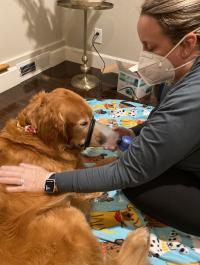
In a remarkable case of perseverance and cutting-edge veterinary treatment, Lola, a 9-year-old golden retriever, has defied the odds by overcoming an aggressive form of cancer that had metastasized to her lungs.
Initially diagnosed with oral melanoma in February 2023, Lola’s prognosis was grim. Her veterinarian informed owner Allison Roth that the beloved pet likely had less than six months to live. Seeking advanced treatment options, Roth took Lola to UC Davis William R. Pritchard Veterinary Medical Teaching Hospital’s Oncology Service, renowned for having one of the most comprehensive cancer treatment facilities in veterinary medicine.
“When Lola was a puppy, I was treated for a brain tumor at the Mayo Clinic,” said Roth. “Through my multiple brain surgeries, she was always by my side. When it came time for her cancer treatments, I was thrilled that she would be treated at UC Davis – what I would call the ‘Mayo Clinic for dogs.’”
Faced with either palliative radiation or participation in a clinical trial, Roth opted for the groundbreaking immunotherapy treatment study at the school’s Veterinary Center for Clinical Trials. The study, titled “Intravenous Doxorubicin and Inhaled IL-15 Immunotherapy for Treatment of Lung Metastases,” was a collaborative effort between veterinary oncologists Drs. Robert Rebhun and Michael Kent, along with Dr. Robert Canter, a surgical oncologist from UC Davis Comprehensive Cancer Center.
“The previous trials we conducted found that inhaled IL-15 is well tolerated and resulted in durable responses in a subset of dogs with metastatic melanoma or osteosarcoma,” explained Dr. Rebhun. “We were excited to see if modulating the immune system with chemotherapy might improve response rates in patients with metastatic tumors to the lung.”
Initially, Lola’s response was discouraging. She struggled with the chemotherapy and subsequent x-rays showed tumor growth rather than reduction. After “failing out” of the trial, Lola received six palliative radiation treatments in May and June 2023.
What happened next stunned everyone. Although post-radiation x-rays continued to show tumor growth in Lola’s lungs, a follow-up scan in September revealed something extraordinary – all her tumors had disappeared.
“We thought we were going to lose her that summer,” Roth recounted. “But she hung on all summer, and we did another x-ray in September. All her tumors were gone. No one could believe it. Essentially, Lola had experienced a delayed response to the IL-15 trial.”
Dr. Rebhun noted this phenomenon is known in human medicine as “pseudoprogression,” where immunotherapies can initially cause tumors to appear larger due to inflammation before they shrink.
Nearly two years after her diagnosis, Lola remains cancer-free. Regular check-ups at UC Davis show no sign of tumor recurrence. Her remarkable recovery not only demonstrates the potential of innovative veterinary treatments but also highlights the importance of preventive healthcare for dogs and the advances being made in veterinary oncology.
“I don’t know how to express how grateful we are for allowing Lola to be in the trial and for all the care she’s received at UC Davis,” said Roth.
Lola’s success story serves as an inspiring example of how clinical trials in veterinary medicine can lead to breakthrough treatments, offering hope to pet owners facing similar diagnoses.
Source: https://www.vetmed.ucdavis.edu/news/dog-beats-cancer-odds-after-successful-completion-clinical-trial