
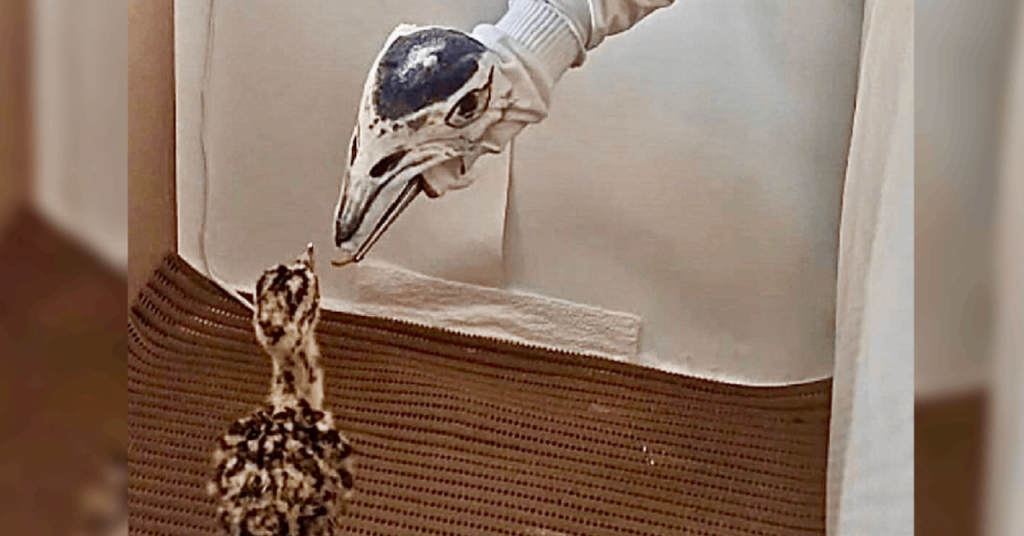
In a controlled enclosure in Rajasthan, two Great Indian Bustard chicks have just hatched.
Small, downy, and still unsteady, they may not look like much at first glance. For a bird hanging on by a thread in the wild, their arrival carries unusual weight.
With these two hatchlings, the number of Great Indian Bustards in captivity has reached 70, marking another step in India’s effort to save one of its rarest birds. One chick was born through natural mating on 10 March 2026, and the other through artificial insemination on 12 March at the Conservation Breeding Centre in Sam, Jaisalmer.
Officials say some of this year’s captive-bred chicks will be soft-released into the wild, where they can gradually adapt to their natural habitat.
For a species with only a few hundred birds left in the wild, every hatch matters.
A bird on the edge
The Great Indian Bustard once moved across the dry grasslands of the Indian subcontinent with ease.
Tall, long-legged, and unmistakable with its black crown and sandy-brown body, it was once considered for the title of India’s national bird before the peafowl was chosen instead. Adult males can weigh up to around 12 kg, placing them among the heaviest flying birds in the world.
Over time, that familiar presence has thinned dramatically.
Hunting, habitat loss, egg collection, and, more recently, collisions with overhead power lines have pushed the species into steep decline. It is now listed as Critically Endangered, and Rajasthan remains its last stronghold in India. Recent census reporting from Jaisalmer estimated around 130 ± 21 birds in the wild there, while breeding centres recorded 68 birds before the latest two chicks took the captive tally to 70.
Where the recovery began
India’s captive breeding effort took shape over the past few years as it became clear that protecting the bird in the wild would not be enough on its own.
The programme in Rajasthan, led by the state Forest Department with scientific support from the Wildlife Institute of India, aims to stabilise the population and slowly rebuild it using controlled breeding, artificial incubation, and assisted reproduction where needed. Officials describe the current phase as the fourth year of captive breeding under Project Great Indian Bustard.
That scientific support has become crucial because Great Indian Bustards breed slowly, and natural mating rates in captivity can be low.
One of the chicks hatched this week was born through artificial insemination, a technique where semen is collected and introduced into the female reproductive tract to support fertilisation when natural breeding is limited. This work is also helping build a sperm bank for the species, with support and training involving the Wildlife Institute of India and the International Fund for Houbara Conservation in Abu Dhabi.
The Great Indian Bustard primarily lays a single egg per breeding season in unlined ground scrapes. Photograph: X@BhupendraYadav
To understand what this work looks like on the ground, The Better India sat down with Dr Tushna Karkaria, Lead Veterinarian with Project Great Indian Bustard at the Wildlife Institute of India.
Artificial insemination has become a crucial tool in the programme, especially since moving birds between locations is often not feasible. “In artificial insemination, you cannot shift individuals, so this method allows conservationists to work around logistical and biological constraints,” she explains.
Natural breeding comes with its own limitations. “Natural breeding is difficult to ensure genetic diversity,” she says, pointing to one of the central challenges in managing a critically small population. Artificial techniques remain a work in progress for this species. “It is being done for the first time, so it is slightly uncertain because it differs from individual to individual.”
Much of that uncertainty plays out in the day-to-day work of conditioning the birds.
Dr Karkaria describes how behavioural training, especially using dummy models, often requires constant adjustment. “Sometimes the individuals are scared, so we had to make the dummies more realistic so that they get acclimatised.” Even then, responses vary, and progress comes gradually.
The process begins by introducing a dummy female to the male, though even this step requires careful modification based on how each bird responds.
The species’ sensitivity extends beyond breeding behaviour. “They are sensitive. Sometimes the females need their keepers to be around when they are tending to eggs, because it reassures them,” she adds.
That balance between intervention and independence becomes even more important as birds are prepared for release into the wild. “The ones that are going to be released will be trained to find their own food,” Dr Karkaria says. For these chicks, human interaction is reduced over time, with limited to no intervention as they approach release.
Birds shaped by care
In their early months, the chicks remain dependent. “Initially, they are dependent on their mothers completely. In the wild, the mothers distance them when required, but here we keep them with the mother for about four to five months,” she explains.
This period allows conservationists to monitor growth closely. Only once the birds show adequate physical development are they considered ready. “When we are satisfied with their growth and muscle development, only then do we radio-tag them and release them into the wild,” she says.
Even with careful preparation, survival remains uncertain.
Some of this year’s captive-bred chicks will be soft released in the wild, marking a new, challenging beginning for the project. Photograph: X@BhupendraYadav
“Sixty to 70 percent will not survive, but 20 to 30 percent will,” Dr Karkaria says. Predation and the inability to find food remain major challenges in the early stages. “The mortality rate will be high, but eventually the success rate goes up as they start adapting.”
Her assessment reflects the reality of conservation at the edge, where progress depends on persistence.
Captive breeding for a species like the Great Indian Bustard involves far more than getting an egg to hatch.
Apart from scientists, keepers also play a key role, closely observing behaviour and helping the birds adapt. Some chicks are raised with careful human guidance early on, so they can later respond to cues that support breeding in captivity. This daily, hands-on effort has become part of the larger attempt to give the species another chance.
The work moves slowly, and progress often shows up in small moments. Sometimes it is a successfully incubated egg. Sometimes it is a chick surviving its first few days.
Rewilding aviary at Ramdevra Conservation Breeding Center trains chicks before release. Photograph: Dr Tushna Karkaria, Lead Veterinarian, Project Great Indian Bustard (WII)
The next test
Reaching 70 birds in captivity marks a meaningful milestone. The harder question lies ahead.
Can these birds return to the wild and survive there?
That is where the planned soft release becomes important. Instead of being sent directly into open habitat, some of the captive-bred chicks will be released gradually, giving them time to adjust to the surrounding landscape.
For the Great Indian Bustard, recovery will depend on more than breeding numbers. It will depend on whether these birds can find their way back to the grasslands that once supported them in far greater numbers.
For now, in a breeding centre in Rajasthan, two new chicks are alive. For a species this close to disappearing, that is reason enough to keep going.