
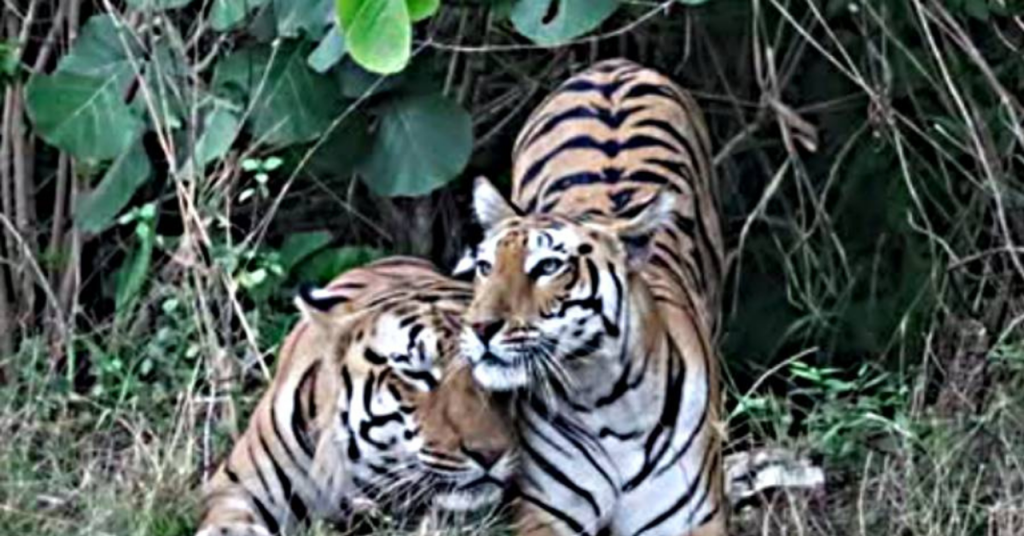
In the dry deciduous belt of the Malwa-Nimar region in western Madhya Pradesh, extending slightly into Rajasthan, a tiger couple has rewritten the fate of a forest.
Yuvraj and Meera, now the dominant pair at Kheoni Wildlife Sanctuary, have done more than establish territory; they have made Kheoni their home.
They held territory, hunted, and eventually, they bred.
Last month, the Dewas forest department confirmed what the camera traps had been suggesting for weeks: Meera had given birth to three cubs.
Now, at just a few months old, they are beginning to emerge, slipping out of the undergrowth in padding across clearings under their mother’s watch.
They are now moving through a forest that, not long ago, could barely hold their kind.
Passage to presence
For decades, Kheoni was known as a “quiet corridor,” linking larger, better-known habitats like Ratapani Wildlife Sanctuary and the distant Melghat Tiger Reserve.
Tigers passed through, but they didn’t stop for long enough to claim it.
At 134.7 square kilometres, the sanctuary seemed too small, too exposed, too dependent on neighbouring forests to sustain a resident population.
But that assumption no longer holds. Forest department data now places Kheoni’s tiger population at around a dozen individuals.
Sightings, once rare and anecdotal, have become routine.
The ‘power’ couple
Yuvraj and Meera settled in Kheoni.
In ecological terms, it marked the point at which Kheoni crossed a threshold, where prey density, territory, and safety aligned enough to support breeding.
Their arrival adds context to the predator hierarchy, joining leopards, hyenas, jackals, and sloth bears already present in the sanctuary Photograph: (Gaurav Sharma Dadhich- Facebook)
That threshold became visible last month with the confirmation of the births because a breeding tigress does not choose uncertainty. She selects a landscape that can sustain risk.
Superintendent Vikash Mahorey reportedly described the early weeks as cautious. Meera remained hidden, moving carefully, shielding her cubs. Now, as the cubs begin to feed independently and explore, they have become the sanctuary’s most closely watched inhabitants.
A forest that’s filling in
The tiger story is only the most visible layer of a broader ecological recovery.
Recent field reports confirm the presence of dholes (wild dogs) that operate in coordinated packs and require substantial prey availability.
Their arrival adds context to the predator hierarchy, joining leopards, hyenas, jackals, and sloth bears already present in the sanctuary.
Among herbivores, the four-horned antelope, or chousingha, is also an indicator of niche diversity within the habitat.
So, it is not just a single-species success. It is the rebuilding of the predator and prey relationship.
The long view pays off
Part of this resurgence traces back to a decision made decades ago. In 1982, Kheoni’s boundaries were expanded to include forest tracts in Sehore district. At the time, it was a bureaucratic adjustment.
That additional space has allowed prey populations to grow, movement corridors to stabilise, and territorial behaviour to take root.
Now, the state is planning to develop the Omkareshwar Wildlife Sanctuary to strengthen the corridor network, linking central Madhya Pradesh with Maharashtra.
The goal is to ensure that dispersing tigers, including Meera’s cubs, have somewhere to go.
What Kheoni now represents
Kheoni’s transformation shows how landscapes written off as secondary can become central, if protected consistently and allowed to recover.
But the story definitely circles back to the power couple, Yuvraj and Meera. They are the reason the sanctuary is spoken about differently now.
Sources:
‘How a Tiger Couple Is Resurrecting Madhya Pradesh’s First Wildlife Sanctuary: The Kheoni Success Story’: By Arjun Mehra, Published on 8 April 2026
‘Tiger Couple Resurrects MP’s ‘First’ Sanctuary’: by Times of India, Published on 7 april 2026
‘Kheoni: The Uncharted Wild Heart of Madhya Pradesh’: By Madhya Pradesh Tourism, Published on 30 January 2026