
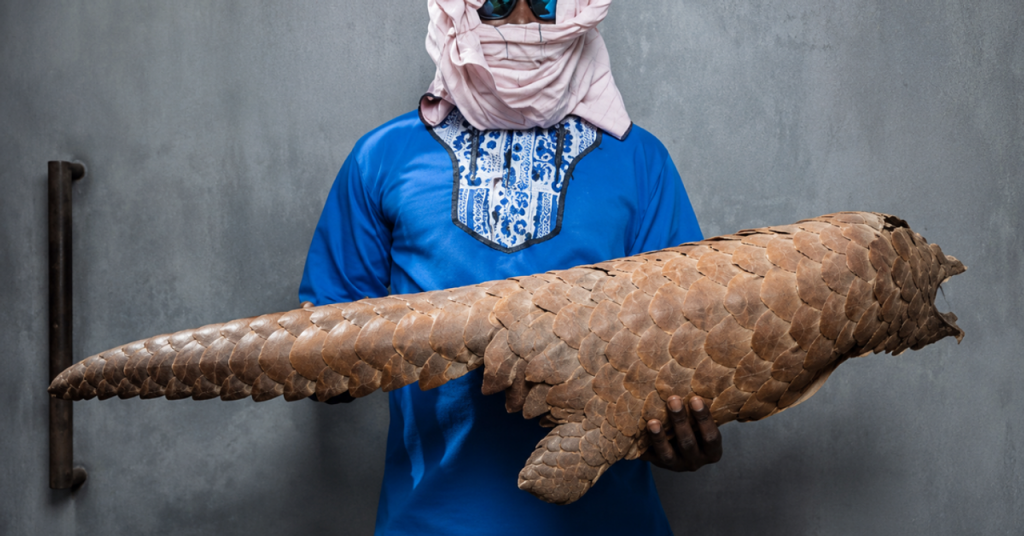
Scientists tracing a suitcase full of seized pangolin scales may soon be able to tell not just what species the scales came from, but the exact forest where the animal once moved through the undergrowth.
That possibility could reshape the fight against one of the world’s most secretive wildlife crimes.
A new international study has shown that DNA recovered from trafficked pangolins can now be used to map illegal wildlife trade routes with remarkable precision, helping investigators identify poaching hotspots and track organised trafficking networks across borders. But how?
For India, home to the Indian Pangolin and the critically endangered Chinese Pangolin, the implications are significant. The country has become both a source and transit point in a sprawling illegal trade network stretching from forests in Odisha, Chhattisgarh, and Maharashtra to smuggling corridors running through Myanmar into China.
A mammal vanishing quietly
Unlike elephants or tigers, pangolins disappear without much public attention.
These shy nocturnal mammals, often called “scaly anteaters”, are hunted primarily for their keratin scales, which are illegally traded in traditional medicine markets despite there being no scientific evidence supporting their medicinal use.
Their meat is also sold in underground luxury wildlife markets.
Over the past decade, the trade has become increasingly organised.
A major study published in the European Journal of Wildlife Research documented 426 pangolin seizure cases in India between 1991 and 2022, involving an estimated 8,603 pangolins. Yet only around 1.4% of those cases resulted in convictions.
Research published in Forensic Science International Reports showed how pangolin scales frequently move through Myanmar before entering Chinese wildlife markets. Photograph: (goodnewsnetwork.org)
The numbers reveal a troubling pattern: seizures are rising, but trafficking networks continue to survive.
Researchers found that pangolin scales moved through layered interstate routes involving middlemen, scouts, hidden transport compartments, and border corridors — systems that increasingly resemble narcotics trafficking operations.
India’s northeastern states have emerged as a key link in this chain. Research published in Forensic Science International Reports showed how pangolin scales frequently move through Myanmar before entering Chinese wildlife markets.
The science behind the breakthrough
For years, wildlife investigators faced one major limitation: once pangolin scales were seized, it was often impossible to determine where the animal had originally been poached.
That may now be changing.
In a study published in PLOS Biology, French researchers developed a gene-capture technique capable of extracting usable DNA even from degraded pangolin samples, including seized scales, old museum specimens, and market remains.
The team analysed more than 700 pangolin samples collected from international trafficking seizures, bushmeat markets, museum collections, and wild populations.
Using specimens with known geographic origins, scientists then built what they describe as a genomic “reference map” for pangolins.
The result allows trafficked animals to be traced back to their likely source regions.
“We’ve shown that it’s possible to trace trafficked pangolins back to their geographic origin with remarkable precision — sometimes to within just a few kilometres,” says Dr Sean Heighton of the University of Toulouse, one of the study’s researchers.
The findings identified several major wildlife collection hotspots, including Myanmar and regions across Africa, while also revealing how domestic and international wildlife markets often overlap and feed into each other.
What this could mean for India
For Indian wildlife agencies, DNA tracing could change how investigations are conducted.
At present, authorities often struggle to connect separate seizures or prove where confiscated scales originated. Cases frequently collapse because of weak forensic evidence, poor documentation, and long delays in prosecution.
A national pangolin genomic database could help investigators identify repeated poaching zones across forests in Odisha, Maharashtra, central India, and the Northeast. Seized scales from different states could potentially be linked back to the same trafficking syndicates.
Instead of arresting only couriers or low-level handlers, investigators may be able to map larger criminal supply chains.
Recent seizures already hint at how extensive those networks have become.
Earlier this year, Gujarat authorities intercepted a live pangolin hidden inside luggage in an SUV. Investigators later uncovered what officials described as an interstate wildlife trafficking network valued between Rs 5 crore and Rs 8 crore.
Officials said the animal had been poached in Maharashtra’s Gadchiroli forests before moving across multiple states using spotters to avoid checkpoints.
In Chhattisgarh, the Directorate of Revenue Intelligence seized 17 kg of pangolin scales while dismantling another interstate syndicate. Maharashtra forest officials separately arrested a man carrying nearly 6 kg of scales at a bus stand in Mahabaleshwar.
Beyond seizures
Alongside DNA tracing, scientists are also developing AI-powered systems capable of identifying illegal wildlife products such as pangolin scales through smartphone photographs.
But technology alone cannot save the species.
Without stronger convictions, coordinated interstate investigations, and long-term investment in wildlife forensics, traffickers are likely to continue operating with minimal risk.
For now, though, science is beginning to expose something traffickers have long relied on: anonymity.