
You did everything right today. A forty-five-minute walk this morning (the long route with the good sniffing along the fence line). Twenty minutes of fetch after work, until your shoulder started making a noise that shoulders shouldn’t make. You even filled the puzzle feeder, because someone on the internet said that counts as mental stimulation.
And now it’s 9 PM, and your dog has just completed his fourth lap around the coffee table at a speed suggesting he’s being pursued by something only he can see. Underneath the frustration, you quietly wonder if you’re failing this dog. Or maybe something is wrong with him.
So let me tell you the thing nobody mentions at the adoption event, dog parent to dog parent: Nothing is wrong with your dog. And nothing is wrong with you.
Your dog doesn’t have a behavior problem. He has an outlet problem. From your couch at 9 PM, those look identical, but they have opposite solutions, and the reason nothing has worked is that you’ve been solving the wrong one.
Let’s fix that because the solution is simple: it lives in your backyard and only takes about fifteen minutes a day.
Your Dog Isn’t Bad, He’s Just Unemployed.
Run through this list. (Be honest)
Holes in the yard, usually in the same three spots
Chewing that escalates the second you leave the room
Counter surfing
Barking at nothing, with tremendous conviction
Indoor zoomies at genuinely inappropriate hours
Pacing
Following you room to room to room, bathroom included
If you checked four or more, you’ve probably been filing those under “bad dog.” Almost everyone does. But they’re not really behavior problems. They’re job applications.
Every one of those behaviors is a dog with unspent energy inventing something to do because nobody gave him a task to focus it on. Digging is a job. Shredding is a job. Patrolling the house and barking at the mail carrier is absolutely a job. Your dog isn’t defying you; he’s clocking in. You didn’t assign him a shift, so he assigned himself one. In your yard. Or on your shoes.
This distinction decides what you do next.
Owners who see a bad dog reach for correction. More rules, firmer no’s, maybe more crate time. It sort of works for about a week, and then it doesn’t, because you can suppress a behavior without ever addressing its cause.
Owners who see a bored dog reach for fulfillment. And that works because it targets the thing that was driving the behavior in the first place.
Here’s the good news hiding in all this: it isn’t a training failure, it isn’t permanent, and it isn’t too late; not at eight months, not at three years, not at twelve.
You just need to give your dog a job that benefits both of you.
Sound Like Your Dog?
If you just mentally checked off four of those behaviors, your dog isn’t misbehaving. He’s under-employed. Valentino Pet Paws builds heavy-duty outdoor tug poles that give high-energy dogs a real job in their own backyard. Use code DOG10 for 10% off your order.
Why Walks Aren’t Enough (And Why They Stopped Working)
You walk your dog, and you walk him a lot. So why isn’t it working?
Let’s do the math nobody does. A thirty-minute leash walk covers maybe a mile and a half, at your pace, with frequent stops for sniffing. For an animal whose great-grandparents worked a farm sunrise to sundown, that isn’t a workout. It’s a warm-up.
And here’s what surprises people: the sniffing genuinely is valuable. Scent work is real mental exercise. But mental work and physical exertion aren’t interchangeable currencies. A long, sniffy walk gives you a dog who’s mentally satisfied and physically still fully loaded. He isn’t being difficult; he just isn’t tired.
Then there’s the problem that eventually catches up with every high-energy dog owner: dogs get fitter.
The walk that flattened your six-month-old puppy barely registers on your two-year-old, because he’s spent eighteen months training for it. So you do the reasonable thing and add time. Forty-five minutes. An hour. Two walks a day. And you get less back each time, because at that point you’re conditioning an athlete, not tiring one out.
The missing ingredient was never distance. It’s intensity.
Steady movement burns energy slowly. Short bursts of hard, full-body effort burn it fast. It’s the difference between a two-hour stroll and ten minutes of sprints. And your dog is built for sprints.
A leash walk structurally cannot give him that. No resistance. Nothing to grip, nothing to pull against, no room to open up flat-out, no chance to use his mouth and his whole body the way he’s wired to.
So, you think, I’ll play more fetch.
Fetch is good, but it’s repetitive. It depends entirely on your arm holding out, and as a sole outlet, all that hard braking and pivoting adds up on your dog’s joints over the years.
What your pooch really needs is something that pulls back.
What Your Dog Is Actually Asking For: A Job
There’s a word trainers use that regular dog owners rarely hear: drive.
Drive is the built-in urge to chase something, catch it, grip it, pull on it, and win. It isn’t aggression, and it isn’t a flaw. It’s the engine, and it came pre-installed.
Look at what’s living in American homes right now. Doodles: poodle plus herding or retrieving stock, all of whom come from working lineage. German Shepherds and Aussies, bred to move livestock all day. Huskies, bred to pull. Labs and goldens, bred to work field and water from dawn until somebody told them to stop. Terriers, bred to go into the ground after something with teeth.
Every one of those breeds had a full-time job. Then, over a couple of generations, we moved them into the living room, handed them a memory foam bed and a squeaky duck, and quietly laid them off.
But nobody told their internal wiring.
An unemployed working dog does what any driven creature does with nothing to do: he invents his own job. And the job he picks is always more expensive than the one you’d have assigned him.
So what does a real outlet look like? It has to hit three things at once:
Physical exertion: hard enough to actually empty the tank, not just top off his conditioning.
Mental engagement: something to track, time, and anticipate.
Instinct satisfaction: the chase, the grip, the pull, the win.
Most of what we buy hits one. A good play session with you hits two. Very little hits all three, which is exactly where most dog parents get stuck.
Because here’s the piece almost everyone misses: draining the battery without satisfying the instinct gives you a wired-and-tired dog. Physically spent, mentally unresolved, still restless. You’ve seen it. He’s panting on the floor and still watching the door.
Satisfy the instinct too, and something different happens. The hard flop. The deep, twitchy, dreaming sleep. And then the part that changes your evenings. Your dog settles instead of patrolling. Not because he’s been exhausted into submission, but because he’s done. He worked. He won. He’s off the clock.
That’s the goal. Not a tired dog. A fulfilled one.
Give Your Dog a Job in Your Own Backyard
Physical exertion, mental stimulation, and instinct satisfaction, all three at once, in about fifteen minutes. The Valentino Pet Paws tug pole rotates a full 360 degrees so your dog can chase, pull, and sprint until the battery is finally, actually empty. Take 10% off with code DOG10.
Enter the Tug Pole: The Backyard Outlet That Hits All Three
So what hits all three at once, in your own backyard, without requiring you to be athletic?
A tug pole.
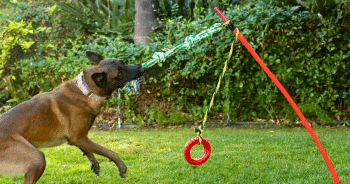
If you’ve never seen one: a heavy-duty pole anchored into the ground with a tug attachment (rope, ball, or tire) that your dog grabs and pulls against. That’s the whole concept. The genius is in what happens next.
The attachment rotates a full 360 degrees around the pole. Sounds like a small engineering detail, but it’s the core of the product.
It means your dog can grab the rope and run, sprint, circle, and reverse to their heart’s content without the line ever wrapping, binding, or killing the game.
And here’s why it burns energy so much faster than anything else in your yard: resistance.
Running in a straight line is easy for your dog. Running while gripping something that pulls back is not. He’s working against tension the entire time, using his shoulders, hindquarters, core, and jaw. It’s the difference between jogging and dragging a sled. Ten or fifteen minutes on a tug pole does what forty-five minutes of walking can’t, because every second of it is loaded.
Then there’s the feature that quietly matters most: your dog can use it by himself.
You don’t have to be out there. On the days you’re on back-to-back calls, or your back hurts, he can “go to work” on his own. That’s not a small thing when you’re the entire recreation department for an animal with a full tank.
The attachments change the game depending on your dog. Rope for the tuggers. Ball for the ball-obsessed. Tug tire for the dogs who want something substantial to really commit to.
What dog parents notice first isn’t the play. It’s the two hours afterward.
Valentino Pet Paws Is Built Different
Now the honest part.
Tug poles as a category are great. Most tug poles as products are not. Look around, and you’ll find plenty built for the product photo rather than for a ninety-pound dog with something to prove. The poles are thin, the rope is weak, and the stake surrenders on the second hard pull.
Valentino Pet Paws’ tug pole was engineered backward from that problem, built around a strong dog first.
The pole is extra thick, with intentional flex. That flex isn’t a compromise; it’s the design. A rigid pole takes the full force of a lunging dog and eventually snaps. A pole that bends absorbs the force and gives it back, which, conveniently, is more fun for your dog.
It’s been tested with more than 100 dogs, including extra-large dogs up to 150 pounds. Not a lab estimate. Actual dogs, actually trying.
The patent-pending adjustable ring encircles the entire pole and can be raised or lowered with stoppers. That’s the piece that makes 360-degree rotation work without tangling, and why one pole grows with a puppy instead of getting outgrown and replaced.
The components are rated to match. Heavy-duty rope for aggressive chewers. Heavy-duty ball for the ball-obsessed. And a ground-grabbing stake designed for soft ground and big dogs, the exact combination that pulls lesser stakes right out of a lawn.
Some people hesitate about installation, so here’s the straight answer. You drive a 22-inch metal base into the ground with a rubber mallet, leaving an inch or two above the surface. (Using a regular hammer? Put a block of wood on top so you don’t chew up the rim.) Soft ground gets the full 22 inches. Then the pole slides in.
That’s it. And the pole slides back out, so you can mow straight over the base and stow the whole thing when playtime’s over. It isn’t a permanent fixture bolted into your yard forever.
They also stand behind it: buy from their site, and if it breaks quickly, they’ll replace it or refund you. That’s an impressive position to take when your customers’ dogs destroy things professionally.
Built for the Dog Who Destroys Everything
Tested with more than 100 dogs, including 150-pounders. The tug pole, heavy-duty rope, and carabiner start at $92, or step up to the complete kit with the tug tire and ball for $135. Use code DOG10 for 10% off, with free shipping on orders over $105. And if it breaks quickly, they’ll replace it or refund you.
The Sheepadoodle Who Started It All
Quick story, because it explains why this tug pole exists at all.
Carol Brymm adopted her Sheepadoodle, Valentino, at seven weeks old. Unfortunately, this devastatingly cute cloud of fur arrived with no warning label.
What she’d actually brought home was a working dog in a very fluffy costume, and Valentino had a battery that never seemed to run down. She walked him. Walked him more. Walked him again.
Walks weren’t enough. (You knew that was coming.)
So she went looking for a tug pole that could survive him and couldn’t find one. Everything on the market was flimsy, overpriced, or both. So she built one.
Valentino got his outlet. He also got a title: cofounder, namesake, and chief product tester. He is exceptionally good at the third one.
Your Dog’s First Week With a Tug Pole
Here’s how the first week usually goes.
Pick your spot. Open, level ground with room for a full circle in every direction, away from fences, patios, garden beds, and anything with a corner. Your dog will be moving fast and thinking slowly. Give him room.
Day one is about interest, not exercise. Don’t try to tire him out; just get him curious. Short, high-energy invitations: grab the rope, wiggle it, act like it’s the greatest thing that has ever happened in this yard. Then let him win. A dog who wins early comes back for more.
If he’s hesitant, cheat. Some dogs need a reason to engage the first time. A smear of peanut butter or a treat on the attachment builds the association fast, and you won’t need it long.
Build duration gradually. Two or three short sessions beat one marathon, especially that first week. Watch for heavy panting, slowing down, or losing interest, and stop before he’s done rather than after. You want him wishing he’d had more.
Then, somewhere around day four or five, you get the moment. He comes inside, hits the floor, and sleeps. The real, heavy kind, the kind you haven’t seen since he was a puppy.
Which Setup Is Right for Your Dog
Sizing goes by your dog’s weight, and each kit ships with the correctly sized rope, ball, and tire:
Small — 10 to 30 pounds
Medium — 30 to 50 pounds
Large — 50 to 100+ pounds
Got a puppy? Medium- and large-breed puppies blow through small attachments fast. Get a small rope and ball for now, plus a large rope for the growth spurt you’re sure to witness. The adjustable ring handles the height change as he shoots up.
There are two ways to buy. The pole, rope, and carabiner setup runs $92. For that, you get the full core experience: pole, 360 rotation, heavy-duty rope. If your dog is a dedicated tugger, that’s plenty.
The complete kit adds the tug tire and heavy-duty ball for $135. Worth it if your dog burns through novelty quickly, if he’s ball-obsessed, or if you’ve got more than one dog with different opinions about fun. Rotating attachments is what keeps engagement high for months, not weeks.
Kits ship from the U.S., and shipping is free on orders over $125, which the complete kit clears.
Save 10% on the Complete Kit
iHeartDogs readers get 10% off the full Valentino Pet Paws package (pole, heavy-duty rope, tug tire, and ball) with code DOG10 at checkout. Even after the discount, the complete kit still clears the $105 threshold for free shipping. Just pick your dog’s weight class and it ships with the right-sized attachments.
Before You Buy: The Honest Answers
Is a tug pole safe for my dog’s teeth and neck?
Tugging is natural for dogs, but technique matters. The pole’s flex absorbs force rather than transferring it into your dog, which is the whole argument for a flexible pole over a rigid one. Keep sessions on level ground, let your dog do the pulling, and supervise puppies. If he has known dental, neck, or joint issues, check with your vet first.
Will it work for a small dog, or is this only for big breeds?
It works for small dogs, too. There’s a size built for 10 to 30 pounds, with appropriately sized rope and ball. Small dogs are often the most under-exercised because owners assume a small body means a small battery. Ask any Jack Russell owner how that theory is holding up.
My dog has destroyed every toy I’ve ever bought. Will this one last?
It’s been tested with over 100 dogs, including 150-pounders, and the rope is built specifically for aggressive chewers. The brand’s stated position: buy from their site, and if it breaks quickly, they’ll replace it or refund you. Nobody can guarantee a toy against every dog on earth, but they put money behind the claim.
How long does installation take, and can I still mow my lawn?
Installation takes minutes: drive the 22-inch base in with a rubber mallet, slide the pole in. No concrete, no drilling. And you mow right over it. The pole slides out, and the base sits low enough for the mower to pass.
How much time per day does my dog need on it?
Ten to fifteen minutes of hard, resisted work does more than most hour-long walks. Two short sessions a day is a solid target for a high-energy dog.
Will this fix my dog’s destructive behavior on its own?
It addresses the boredom-driven kind, which is most of it. It won’t resolve separation anxiety, fear-based behavior, or anything with a medical cause. Those issues require a trainer or a vet. But if the root problem is unspent energy, this is the missing piece.
What if he ignores it at first?
This is normal. Some dogs are instantly obsessed; others take a few days. Just remember: short sessions, high energy, a little peanut butter, and let him win.
A Tired Dog Is a Good Dog
It’s 9 PM again. Instead of wearing run patterns into your carpet, your dog is asleep. Actually asleep: legs twitching, deep in some dream where he finally caught the rabbit.
He didn’t become a better dog. He was never a bad dog. He was simply a dog with a full tank and nowhere to put that energy, waiting for somebody to hand him something worth doing.
That’s the whole secret.
And think about the math: a $135 kit against a running tab of chewed shoes, replaced cushions, re-sodded grass, and the very specific exhaustion of managing a dog who never quite settles. That isn’t a toy purchase. It’s a one-time fix for a recurring problem.
So give your dog the job he’s been asking for with Valentino Pet Paws’ High Energy Tug Toy.
Your Dog Isn’t Bad. He’s Bored. Let’s Fix That.
One pole. Fifteen minutes a day. A dog who finally sleeps through the evening. Valentino Pet Paws ships from the U.S. in small, medium, and large, with the right-sized rope, ball, and tire for your dog. Use code DOG10 for 10% off, plus free shipping on orders over $105.
The post Your Dog Isn’t Bad. He’s Bored. The Backyard Fix That Finally Wears Out A High-Energy Dog appeared first on iHeartDogs.com.