
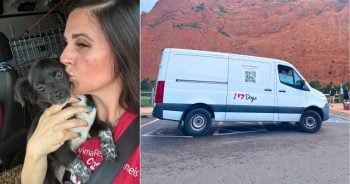
In rural Bosque County, Texas, a call about an abandoned dog does not necessarily bring an animal control officer or lead to an open intake shelter. Often, a dog gets help only when a neighbor, volunteer, foster, or rescue group finds a way to step in.
Alexis Sibila, president of BARK Rescue, knows what it takes to turn that call into a safe place for a dog. Alongside her friend and fellow rescuer Chelsea, she has helped build a transport program that connects Texas dogs with trusted rescue partners in areas where they have a better chance of finding homes. That work became the foundation for the iHeartDogs Rescue Road Trips, supported by the iHeartDogs community and Hero VIP Club members.
But the story of those trips begins years earlier, with two dogs living beneath a bridge. We spoke with Alexis about the dogs who changed her life, the decisions people rarely see behind a rescue, and the road that brought BARK and iHeartDogs together.
This interview has been edited for length and clarity.
An Interview With Alexis Sibila of BARK Rescue
Dina Fantegrossi: Before we talk about BARK, tell readers a little about yourself. Were animals always part of your life?
Alexis Sibila: I’m a small-town Texas girl who loves her family, the outdoors, and being on the water. My husband, Thomas, and I live on ten acres in Central Texas with our four dogs, two cats, two Watusi cows, and a horse.
My dad was a Texas game warden, so my brother and I grew up around all kinds of animals. There was almost always an injured or orphaned wild animal at our house that needed help. We would care for them until they could get to a wildlife rehabilitator. Looking back, those experiences shaped me more than I realized. Helping an animal in need wasn’t presented as something extraordinary. It was simply what you did when something needed help.
Dina: Was there one animal that first taught you what it means to care for another life?
Alexis: My first horse, Cindy. It was my responsibility to make sure she was fed and watered and had everything she needed. My parents made sure I understood that having an animal wasn’t just about the fun part. She depended on me, whether I felt like doing the work that day or not.
Long before I knew rescue would become such a big part of my life, I was learning that caring for animals means showing up for them every day.
Dina: How did you first get involved with animal rescue?
Alexis: About five years ago, I didn’t think my heart could handle walking into a shelter and seeing all the dogs who needed help. I wanted to make a difference, but I didn’t know how many different ways there were to get involved.
I was friends with Jackie, who was BARK’s president at the time, and I told her what I thought I could handle. I knew I had connections and could help with fundraising. She met me where I was and gave me a place to start. Eventually, I learned about fostering and began bringing dogs into my home. That changed everything.
I think my story is a reminder that you don’t have to start by doing everything. You just have to find one way you can help and start there. You never know where that first step might lead.
Dina: You mentioned two dogs who played a major part in pulling you into rescue. What happened?
Alexis: I found two dogs living underneath a bridge. I named them Black Dog and Brown Dog. For five months, I drove there and fed them twice a day. I reached out to shelters and rescues, but everyone was full. They couldn’t help unless I was willing to foster them.
Then both dogs became pregnant, and a terrible storm was headed our way. Something in me said I wasn’t leaving them under that bridge that night, so I brought them home.
I was barely in a financial position to care for two dogs, much less the roughly 23 puppies a veterinarian estimated they were carrying between them. I didn’t have a rescue backing me or the network I have today. I made the painful decision to have both dogs spayed. I had a credit card with a $600 limit, and I spent $567 of it on their surgeries. It still makes me emotional to talk about.
That was when rescue became real to me. Loving animals doesn’t mean you always get to make the easy or happy decision. Those two dogs showed me how desperately our community needed more people willing to get involved. Brown Dog is still with me today.
Dina: How did your role at BARK change after that?
Alexis: I started as an outside volunteer who wanted to help raise money. Then I began attending adoption events, spending time with the dogs, learning about fostering, and seeing how much work happens behind the scenes.
A couple of years ago, I became BARK’s president. Now I’m involved in fundraising, community outreach, fostering, intake decisions, veterinary care, relationships with other rescues, and transport. I went from wondering if I could even walk into a shelter to helping lead an organization that has become one of the biggest parts of my life. Once I saw the need, I couldn’t unsee it. I kept asking, “What else can I do?”
Dina: What challenges do dogs face in rural Texas that people elsewhere might not realize?
Alexis: In many communities, there is no animal control and no open intake shelter. Here in Bosque County, if someone finds a dumped or abandoned dog, there isn’t necessarily an officer who will pick it up or a county shelter where they can take it. That dog stays where it is until a rescue, volunteer, or individual steps up.
There are also far more dogs needing help than there are people able to foster them. Rescues can only save as many dogs as they have safe places for. Affordable veterinary care, especially spay and neuter services, is another huge challenge. We’ve driven as far as six hours to access free spay and neuter services.
In rural Texas, sometimes there is no next phone call to make. If someone doesn’t step up, a dog may simply stay on the road.
Dina: When BARK gets a call about a dog, what happens before the public sees a rescue story?
Alexis: Usually, Chelsea gets the call and lets me know. We start gathering information: Is the dog safe? Is it friendly? Can the finder hold it temporarily? Do we have a foster or kennel? Is there a rescue partner who might be a good fit? Who can go get the dog?
Then we have to think beyond the pickup. Where will the dog sleep? What medical care does it need? How will we pay for it? What is the long term plan? We may be checking for a microchip, calling veterinary clinics, contacting fosters, rearranging kennels, and talking with rescue partners while we’re both working our regular jobs.
Before anyone sees a photo and reads that BARK saved a dog, there may already have been dozens of calls, texts, and decisions. So much of rescue is making a plan where there wasn’t one and figuring out how to safely turn a call for help into a yes.
Dina: What does a typical day look like for you?
Alexis: I’m not sure there is a typical day. I work a full-time job, and Chelsea and I joke that there are about a million calls and texts between us. A day might include picking up dogs dumped on a back road. During a Rescue Road Trip week, my evenings are filled with paperwork, veterinary records, health certificates, and preparing the transport binder. During a spay-and-neuter week, we may be confirming appointments for 28 people.
We’re also moving dogs through other transport partners nearly every week. There is sheltering, fostering, fundraising, veterinary care, and whatever emergency comes next. Rescue doesn’t exactly fit into my schedule. We’ve learned to fit life around rescue.
Dina: What led you and Chelsea to build BARK’s transport program?
Alexis: We reached a point where we had to find another way to save dogs. Our county lost the transport resource we’d been relying on. Adoptions are low in Texas, and without transport, the same dogs could sit in our kennels for months or even years. When the kennels stay full, we have to say no to the next dog.
I realized that if we could move dogs to trusted rescue partners in places where adoption demand was higher, those dogs would have a better chance, and we could open a safe space for another dog here. Chelsea had transport experience, and I was determined to figure out how BARK could do it. We began building relationships, finding partners, and learning the requirements for out-of-state transport.
Another organization let us use its transport van while we got started and eventually donated it to BARK. But the money that allowed us to take our first step came from something much more personal.
Dina: It came from Black Dog’s story, didn’t it?
Alexis: Yes. I lost Black Dog in a tragic accident, and it broke my heart. After she died, about 10 to 15 of my closest friends gave me a card. They had collected money and told me to use it to save dogs in Black Dog’s honor.
Transport brings costs beyond a van and a driver: fuel, hotels, health certificates, vaccinations, flea and tick prevention. My friends’ gift helped us begin, and Chelsea’s experience helped us turn that first step into a program. In our first year, we saved 533 dogs.
Black Dog never got to know what she started, but I do. Every time that van leaves BARK full of dogs headed toward a better life, a little piece of her is with me.
Dina: How did BARK’s transport program become part of iHeartDogs Rescue Road Trips?
Alexis: Our relationship with iHeartDogs began when BARK helped pair a dog with a veteran through Hope Lives Here, a program iHeartDogs was supporting. That experience helped me learn about the iHeartDogs community and the other ways it was helping dogs.
I saw that iHeartDogs had helped fly dogs to safety, and I thought, “What about ground transport?” My husband, Thomas, and I had recently taken a trip to Colorado to Karl’s Canine Krew. I put together a video from the trip and sent it to Catherine at iHeartDogs. I asked whether iHeartDogs would ever consider sharing something like it.
Catherine shared the video with Marshall, iHeartDogs’ CEO. If I’m remembering correctly, Marshall came up with the name Rescue Road Trip. In August 2025, we took our first official trip with the support of the iHeartDogs community. What started as one video and a message has connected us with people across the country who follow these dogs’ journeys.
I’m from a town of about 3,500 people. I didn’t have a grand plan to build something people all over the country would follow. I saw dogs sitting in kennels and more dogs waiting for those kennels, and I knew we needed to create movement. The iHeartDogs community gave our little transport program a platform and helped it become something bigger than us.
Dina: What is the hardest part of rescue for you personally?
Alexis: People might expect me to say it’s seeing the dogs we can’t save, and of course, that is heartbreaking. But one of the hardest parts is the way people sometimes treat us when we can’t help.
If I say we can’t take a dog, Chelsea and I have probably already looked for a foster, checked our kennels, called rescue partners, and tried every other solution we can think of. I’m already carrying the weight of knowing there’s a dog I couldn’t find a place for. Sometimes the person asking for help becomes angry and says things that make it sound as though we don’t care.
Rescue workers aren’t saying no because they don’t care. Sometimes they’re saying no because they’ve already said yes until there’s nowhere else to safely put a dog. Nobody is more disappointed by that answer than I am.
Dina: How do you keep going when you can’t help every dog?
Alexis: I don’t know that I’ve completely learned how to cope with those cases. I think about the dogs I couldn’t help and wonder what happened to them. But I can’t let the dogs I couldn’t save keep me from saving the ones I can.
I focus on what I can do next: building partnerships, finding fosters, creating transport opportunities, and working on spay and neuter programs. Each of those things might mean fewer times we have to say no in the future. You don’t stop caring about the dogs you couldn’t help. You find a way to carry them with you while you keep fighting for the ones you still can.
Dina: How do you protect yourself from burnout?
Alexis: The biggest thing I’ve learned is to take the vacation. A healthy, happy Alexis can help far more dogs than an Alexis who has given everything until there’s nothing left. I’m lucky to have people like Chelsea and Lacey who let me step away for a few days, knowing the calls will still be answered and the dogs will be cared for.
Taking a vacation doesn’t mean I care any less. Sometimes taking care of yourself is exactly what lets you keep taking care of everyone else.
Every Open Kennel Is Another Chance
Black Dog’s story did not end when Alexis lost her. The gift made in her memory helped BARK start moving dogs to rescue partners, and each successful transport can free a kennel for another dog still waiting in Texas. Through the Rescue Road Trips, iHeartDogs supporters and Hero VIP Club members have helped carry that effort farther, giving more people a chance to follow these dogs from an uncertain beginning toward the possibility of a home.
Alexis’s account also makes clear how many people it takes to make a trip possible: the person who answers the first call, the foster who opens a door, the veterinary team preparing a dog to travel, the partners ready to welcome that dog, and the community willing to support the journey. What began with two dogs under a bridge continues each time BARK’s van pulls away with another group of dogs aboard.
The post The Little Black Dog Behind iHeartDogs Rescue Road Trips appeared first on iHeartDogs.com.