
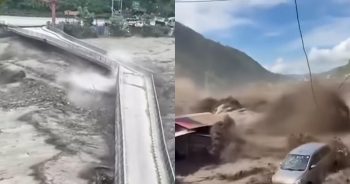
What began as an ordinary morning in the Himalayan borderlands became a catastrophe within minutes. A tremendous mass of glacial ice, rock, and debris broke loose high in the mountains near the Nepal-China border, unleashing a violent torrent that raced through communities below.
The surge tore through the Trishuli river system with extraordinary force, sweeping away homes, bridges, roads, and critical infrastructure while leaving thousands of families searching desperately for loved ones. Days later, rescue teams are still digging through mud, entering blocked tunnels, and searching rivers far downstream as the staggering scale of the tragedy continues to emerge.
The disaster struck on August 26, 2026. Early reports raised the possibility that an earthquake had triggered the flooding, but subsequent analysis indicated that the seismic signal was generated by the enormous collapse itself rather than an earthquake setting the disaster in motion.
Satellite imagery and preliminary scientific assessments point toward a massive slope failure involving glacial ice and rock. Researchers are continuing to investigate the precise sequence of events, but the collapse sent an enormous amount of material plunging into the steep valley and ultimately generated the devastating debris flow and flood downstream.
As the material raced through the mountains, it gathered water, sediment, rocks, and other debris. In parts of the affected river system, water levels reportedly rose by as much as 9 meters in approximately 30 minutes, leaving communities along the river frighteningly little time to react.
A Disaster Still Unfolding
The human toll has continued to rise as rescuers reach places that were initially inaccessible. As of August 31, at least 919 people had been confirmed dead across Nepal and Tibet, while 4,793 people remained missing.
Nepalese authorities reported 903 confirmed deaths and 4,247 people missing. On the Chinese side of the border, authorities reported 16 deaths in Gyirong County and another 546 people unaccounted for.
Foreign travelers and pilgrims are among those still missing. Nepal’s foreign ministry reported that approximately 590 foreign nationals from 39 countries remained unaccounted for, while Chinese authorities said 261 foreign nationals from 23 countries were missing in Tibet.
Despite the enormous numbers, rescuers are still finding people and bringing them to safety. More than 10,000 people have been rescued from Nepal’s flood-stricken region, including hundreds of foreign nationals.
Hundreds of Hydropower Workers Remain Unaccounted For
One of the most urgent rescue efforts is taking place at damaged hydropower facilities in Nepal’s Rasuwa and Nuwakot districts. Authorities say 933 workers are unaccounted for at 11 hydropower projects, with many believed to have been working inside approximately half a dozen tunnels when the disaster struck.
Rescue crews are now trying to reach those tunnels through enormous deposits of mud, rocks, and debris. Teams have used excavators, searchlights, and controlled blasts as they attempt to clear entrances and find ways inside.
The Nepal Army reported that teams had managed to enter two tunnels and recover three bodies, but other sections remained buried beneath debris. The search is continuing under extremely difficult and potentially dangerous conditions.
The tunnel operations have also brought specialized assistance from neighboring countries. Nepal has turned to experts from China and India for help with the complex effort to reach workers who may remain trapped underground.
For families waiting outside the disaster zone, every hour adds to the uncertainty. Rescue officials have made opening the blocked tunnels one of their highest priorities as teams continue searching for any possibility that people survived inside.
Entire Communities Have Been Transformed
The flood left an extraordinary trail of destruction through the Himalayan river corridor. Buildings disappeared beneath thick layers of mud and debris, bridges were destroyed, roads were severed, and major hydropower facilities sustained devastating damage.
Satellite images captured after the disaster revealed how dramatically some areas had changed. At the Rasuwagadhi border crossing between Nepal and China, structures visible before the disaster were replaced by a landscape scoured by water and covered in mud and debris.
The destruction has also made the rescue operation considerably more difficult. Roads normally used to reach mountain communities have vanished or become impassable, forcing responders to rely on helicopters, heavy machinery, drones, and other equipment to search areas that can no longer be reached normally.
For survivors, the losses extend far beyond damaged buildings. Families have been separated, livelihoods have disappeared, and entire communities face the prospect of rebuilding in landscapes that were dramatically reshaped within minutes.
The Red Cross estimates that more than 90,000 people in Nepal have been affected by the disaster. Many now face displacement, disrupted transportation and power, and an uncertain wait for news about relatives who remain missing.
The Search Has Stretched Far Downstream
The power of the flood carried victims and debris enormous distances from the places where they disappeared. Search teams have continued looking along rivers far downstream, where bodies have been recovered days after the initial catastrophe.
Identifying some of the victims has become another heartbreaking challenge. Hundreds of bodies have been recovered, many of them unidentified, and authorities have collected DNA samples from victims before burial in hopes that families may eventually receive answers.
Nepal Army teams were still searching waterways on August 31, including areas along the Narayani River far downstream from the original disaster zone. The vast search area illustrates how far the force of the flood carried people and debris through the river system.
For thousands of families, that means the disaster remains painfully unresolved. Even as rescue work continues in the mountains, other teams are searching rivers and debris fields for those who never made it out.
Another Threat Formed in the Mountains
The original collapse also created new dangers upstream. Accumulated debris blocked waterways and formed a barrier lake near the Nepal-China border, raising fears that a sudden breach could send another destructive surge downstream.
Those concerns have repeatedly interrupted rescue operations. Bad weather and fears surrounding the unstable lake have forced teams to suspend searches at times while authorities assessed whether it was safe for rescuers to return.
Although the lake began overflowing and the immediate threat eased enough for some operations to resume, the danger in the mountains has not disappeared. Authorities continue monitoring the area because additional glacier collapses, landslides, or new blockages could create further flooding.
Drone observations have revealed multiple landslide deposits along riverbanks near the disaster zone. Glaciers surrounding the enormous area affected by the initial collapse are also being watched for signs of additional instability.
The possibility of another disaster is particularly frightening for communities that have already endured one. Rescue teams must now balance the urgency of reaching missing people with the risk that unstable mountains and blocked waterways could put rescuers themselves in danger.
Why Himalayan Glacier Disasters Can Become So Destructive
Scientists are still working to understand exactly what happened on August 26, but the catastrophe demonstrates how one failure high in the mountains can trigger a chain of events far downstream.
When enormous quantities of ice and rock suddenly break loose on steep terrain, the material can accelerate rapidly. If the avalanche enters a river valley, it can collect water, sediment, boulders, trees, and other debris, creating a much larger and more destructive flow.
Natural dams can make the situation even more dangerous. Landslides and glacier debris may temporarily block rivers, allowing water to accumulate behind them before the barrier eventually fails and releases another sudden surge.
The Himalayas are particularly vulnerable to these cascading hazards because of their steep terrain, glaciers, unstable slopes, and extensive river systems. Rising temperatures are also changing high-altitude environments across the region, although scientists caution that determining exactly how climate change contributed to an individual event requires careful study.
What is clear is that glacier instability poses a growing challenge for communities, infrastructure, and hydropower projects throughout high mountain regions. The August 26 disaster has shown how an event beginning in a remote area high above populated communities can become a humanitarian catastrophe many miles downstream.
Thousands of Families Are Still Waiting
Five days after the collapse, this disaster cannot yet be spoken about entirely in the past tense. Heavy machinery is still digging through debris, rescuers are still trying to enter blocked tunnels, soldiers are still searching rivers, and thousands of families are still waiting to learn whether someone they love will come home.
The numbers are almost impossible to comprehend. More than 900 people have been confirmed dead, nearly 4,800 remain missing, and tens of thousands more have been affected by a disaster that transformed communities in a matter of minutes.
Yet amid the devastation, rescue teams continue searching. More than 10,000 people have already been brought to safety, and responders from multiple countries are working alongside local crews in the hope that more lives can still be saved.
For the communities below the Himalayas, recovery will extend long after the searches end. Homes, roads, bridges, workplaces, and familiar landscapes are gone, but for thousands of families, the most urgent hope remains much simpler: finding the people who are still missing.
The post Did a Collapsing Glacier Trigger Nepal’s Deadly Flash Flood? appeared first on iHeartDogs.com.