
As Congress considers H.R. 9436, a bill that would further delay protections for the critically endangered North Atlantic right whale, opposition is clear from constituents and conservation leaders across the East Coast.
Letters from community leaders across the Southeast and from New York and New Jersey, coupled with new polling data from voters in New York, highlight concerns that Congress may postpone actions necessary to protect a species that is already on the brink of extinction.
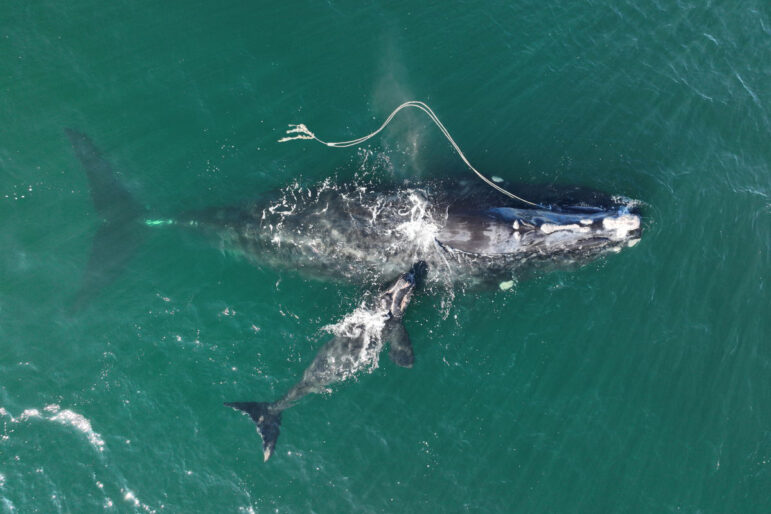
North Atlantic right whale named Snow Cone and her calf sighted off Fernandina Beach, Florida. Credit: Florida Fish and Wildlife Conservation Commission. Taken under NOAA Permit # 20556-01.
The North Atlantic right whale is one of the world’s most endangered large whale species. With only a few hundred individuals remaining, every birth, injury, and death has significant consequences for the population’s future.
Scientists have consistently identified entanglement in commercial fishing gear as one of the leading threats to the species. More than 86% of living North Atlantic right whales bear scars from entanglements. Since 2022, at least fifty-five whales have been killed, injured, or found in poor health. Thirty-one of those cases were directly related to entanglements.
Yet H.R. 9436 would extend existing restrictions on NOAA Fisheries’ ability to implement additional protection measures for North Atlantic right whales, preventing action for another seven years.
Advocates Across the Atlantic Coast Are Speaking Out
Two new letters released by advocates opposing H.R. 9436 demonstrate that opposition to the bill stretches across the Atlantic coast.
The letter from conservation leaders in Southeast states emphasizes the region’s special connection to North Atlantic right whales.
Each year, right whales migrate along the Atlantic coast, with pregnant females traveling to the shallow coastal waters of the Southeast, the only known region where the species regularly gives birth and nurses its calves. Virginia, North Carolina, and South Carolina serve as important migratory and sometimes foraging habitat, while Georgia and Florida encompass the species’ only known calving grounds. The right whales annual migration and calving season inspire community events, educational programs, and public engagement across the region, such as the annual Right Whale Festival held in northeast Florida.
Recognizing this exceptional connection, Georgia has designated the North Atlantic right whale as its official state marine mammal. The North Atlantic right whale is part of the region’s natural heritage and holds cultural significance for coastal communities, serving as a powerful symbol of the shared marine environment that connects our states.
The letter from New York and New Jersey leaders urges Congress to reject further delays and allow NOAA Fisheries to respond to threats using the best available science. North Atlantic right whales are regularly seen in the waters off of Long Island, New York and the Coast of New Jersey. Migrating over 1,000 miles from their northeast feeding grounds to their southern calving grounds, they have already been recorded in the New York Bight and southeast of Atlantic City, New Jersey this year. In 2024, scientists from the New England Aquarium recorded 82 Right whales – including 56 in one day – forty miles south of Long Island. This represents nearly a quarter of the total North Atlantic right whale population.
The call from New York conservation leaders is echoed by voters in New York’s 17th Congressional District, a largely suburban area north of New York City represented by Congressman Mike Lawler, the sponsor of H.R. 9436. A new poll conducted by Public Policy Polling and commissioned by Citizens Campaign for the Environment found strong support for North Atlantic right whale protections among Lawler’s constituents.
The poll found that 63 percent of Lawler’s constituents want Congress to act now to protect North Atlantic right whales, while only 11 percent believe Congress should delay protections for another seven years.
The message is clear: New Yorkers support action to protect North Atlantic right whales and oppose further delays.
Congress Already Gave Industry More Time
Supporters of H.R. 9436 argue that fishermen need additional time to adapt. But Congress already addressed those concerns in 2022.
In 2022, Congress blocked NOAA from implementing new right whale protection measures until 2028, giving the fishing industry an opportunity to pursue voluntary efforts to reduce risks to whales. Many fishermen have participated in those efforts in good faith, working with regulators, scientists, and conservation groups to identify practical solutions.
However, voluntary measures alone have not solved the problem.
Whales continue to become entangled in fishing gear, and serious injuries and deaths continue to occur. While progress has been made, the ongoing threats demonstrate why conservation experts argue NOAA needs the flexibility to implement science-based protections when necessary.
Extending the delay for another seven years would further restrict the agency charged with preventing the extinction of the species.
The Real Cost of Inaction
The consequences of delaying protections are not theoretical. They are visible in the suffering experienced by individual whales.
Deceased female North Atlantic right whale. Credit: Woods Hole Oceanographic Institute/Michael Moore. Taken under NOAA Permit # 24359.
In 2024, NOAA Fisheries confirmed the death of a three-year-old North Atlantic right whale whose story became a tragic example of the dangers posed by fishing gear entanglement.
She was first documented in August 2022 with rope tightly wrapped around her tail and hundreds of feet of fishing line trailing behind her. For 17 months, more than half her life, she endured worsening injuries as the rope cut deeper into her body. The entanglement made it increasingly difficult for her to swim, feed, and survive.
When she was eventually found dead near Martha’s Vineyard, investigators determined that the rope entangling her was used in Maine trap and pot fisheries.
Her death underscores a painful reality: entanglement is not an abstract policy issue. It is one of the leading causes of injury and death for North Atlantic right whales. Every year that meaningful action is delayed increases the likelihood that more whales will experience similar suffering.
Solutions Already Exist
There are solutions that can help protect whales while supporting fishing communities.
One of the most promising innovations is on-demand fishing gear, often called ropeless gear. Unlike traditional systems that leave vertical lines in the water column, on-demand gear allows fishermen to retrieve traps without maintaining ropes that can entangle whales.
Regulatory measures can help accelerate the transition to safer technologies and ensure that risk-reduction efforts occur in the places where they are needed most.
H.R. 9436 would do the opposite. By limiting NOAA’s ability to implement additional protections, the bill would make it harder to address one of the greatest threats facing the species.
As coastal leaders, conservation advocates, and voters increasingly recognize, the North Atlantic right whale cannot afford to wait. Congress already postponed action once. With the species facing ongoing threats and a dangerously small population, lawmakers should reject H.R. 9436 and allow science-based solutions to move forward. Another delay could mean we lose the North Atlantic right whales forever.
The post Congress Should Not Delay North Atlantic Right Whale Protections appeared first on Endangered Species Coalition.