
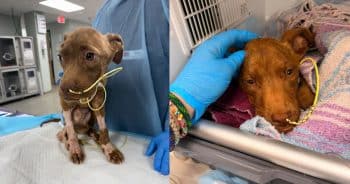
Rudy was barely holding on when rescuers found him on the streets of Houston. The puppy, estimated to be younger than 6 months old, was severely emaciated, dangerously cold, and so weak that simply stabilizing his tiny body had to come before anyone could begin figuring out everything that was wrong.
His temperature had dropped to just 90 degrees, his gums were pale, and his condition was serious enough that ThisIsHouston rushed him to VERGI 24/7 for emergency care. What followed was not a quick turnaround but a long series of frightening setbacks and tiny victories, each one giving the people fighting for Rudy another reason to hope.
Over the next two weeks, the puppy would need a blood transfusion, feeding support, antibiotics, intensive wound care, and round-the-clock monitoring. At times, veterinarians worried about sepsis and even canine distemper, while Rudy became too weak to stand and developed painful wounds from remaining in one position for so long.
Yet little by little, something began to change. Rudy’s numbers improved, his personality started appearing, and the puppy who could barely lift himself eventually stood, barked, took a few steps, and finally reached the milestone everyone had been waiting for. He left the hospital.
Rudy Arrived at the ER Barely Clinging to Life
When ThisIsHouston first shared Rudy’s condition, there was little room for optimism. The young puppy was extremely underweight and hypothermic, with a body temperature of only 90 degrees. His pale gums raised additional concerns, although one encouraging result came quickly when Rudy tested negative for parvovirus. The emergency team focused first on stabilizing him so additional testing could begin.
By the following day, rescuers had learned just how serious his condition was. Rudy arrived with low blood pressure and low blood sugar, although both eventually stabilized with treatment. One of the most alarming findings was his severe anemia. His packed cell volume, or PCV, had fallen to approximately 10 percent, leading veterinarians to give him a blood transfusion.
Rudy was also unable to eat enough on his own and began receiving nutrition through a feeding tube. At the same time, his doctors were trying to determine what was causing such widespread illness in such a young dog.
Doctors Faced a Frightening Medical Mystery
According to ThisIsHouston, Rudy’s veterinary team suspected that an infection, toxin, or another severe inflammatory process could be causing sepsis. His white blood cell count had dropped extraordinarily low, leaving his body with little ability to respond normally while doctors worked through possible causes.
Rudy was treated with broad-spectrum antibiotics as his medical team tried to get the suspected infection under control. By August 19, he had been moved onto a third antibiotic while doctors continued monitoring his response.
Then another frightening development appeared. Rudy began showing neurological signs, including facial twitching and head bobbing, and he could no longer stand. Those symptoms raised concerns about canine distemper, a serious viral disease that can affect the nervous system. Veterinarians sent out a PCR test while Rudy’s caregivers faced an agonizing wait for answers.
The puppy was also dealing with diarrhea, severe weakness, and an exhausted body that had almost no reserves left. At that point, the hopeful updates were measured in extremely small changes. Stable blood sugar mattered. Stable blood pressure mattered. Simply making it through another night mattered.
His Immobility Caused Another Painful Problem
As Rudy remained critically ill and unable to move normally, another complication developed. His rescuers later learned that he had significant pressure sores caused by spending extended periods lying in the same position. One particularly severe wound formed over his hip. A large area of hardened, dead tissue had to be removed, leaving very little healthy tissue underneath and raising the possibility that surgical closure might eventually be necessary.
Rudy also had a wound over his knee. What initially appeared to be exposed bone thankfully turned out to be exposed tissue instead, although there was again very little healthy tissue available to cover the area. The tip of his tail had also become necrotic. At first, rescuers were told Rudy might eventually need part of his tail surgically amputated, adding yet another medical concern to an already overwhelming list.
Even while Rudy’s internal numbers slowly improved, his body carried visible evidence of just how critically ill he had been. His veterinary team continued providing wound care while everyone waited for the little dog to become strong enough to heal.
Then Came the Results Everyone Needed
On August 23, ThisIsHouston finally received one particularly welcome piece of news. Rudy’s distemper test was negative. The facial twitching seen during his earliest days in the hospital had also stopped, and no additional neurological signs had appeared. One of the most frightening possibilities could finally be crossed off the list.
His bloodwork was moving in a better direction, too. Rudy’s temperature was holding steady, his blood sugar remained stable, and his red blood cell count was maintaining around 21 percent after his transfusions.
Perhaps most encouraging of all, Rudy had white blood cells again. His rescuers reported that his count had climbed from around 1.7 to 7.6, a dramatic improvement from the critically low levels seen when he first arrived.
Doctors were also able to remove some of the additives from his fluids as his body became more stable. Then came another small but meaningful milestone: Rudy no longer needed the incubator. For a puppy whose recovery had been measured hour by hour, each of those changes felt enormous.
Rudy Started Acting Like a Puppy
By August 24, the hospital was beginning to see someone new emerge from inside the critically ill little dog. Rudy was becoming alert, opinionated, and increasingly interested in whatever was happening around his kennel.
He had started barking at other patients passing by, which was probably not the most peaceful development for the hospital but was an extremely welcome sign to the people who had watched him struggle to survive.
Rudy was also becoming stronger when attempting to stand. He still could not walk, but ThisIsHouston affectionately noted that he was no longer a “lil noodle” lying helplessly in his kennel.
His care continued with range-of-motion exercises, regular meals every four hours, and close monitoring. His hip wound was treated with a tie-over bandage and hydrogel while the medical team continued watching his bloodwork, particularly his albumin levels.
The loud little bark was not a cure, but it was something everyone desperately wanted to hear. Rudy finally had enough strength to complain about the neighbors.
His First Steps Changed Everything
The next milestone arrived on August 25. Rudy was supporting himself more confidently and managed to take a couple of steps. For most puppies, crossing a room would hardly qualify as major news. For Rudy, simply putting one paw in front of another represented an extraordinary distance from the dog who had recently been unable to stand.
Those steps continued a pattern rescuers had been watching for days. Rudy was eating consistently, becoming more alert, gaining physical strength, and showing more of the goofy personality that had been hidden beneath his illness.
The progress remained slow, but it was finally becoming visible in ways that had nothing to do with bloodwork. Rudy was no longer simply surviving treatment. He was beginning to participate in life again.
One Fever Delayed His Trip Home
Eventually, Rudy became well enough that the veterinary team began planning his release into foster care. His caregivers were preparing for him to leave the hospital when one more complication interrupted the celebration.
Rudy spiked a fever on the morning he was supposed to go home. Rather than risk sending him out too soon, his doctors kept him at VERGI 24/7 a little longer so they could continue monitoring him.
Fortunately, the setback did not erase the progress he had already made. Rudy was completely off IV fluids, eating well, gaining weight, and continuing to become stronger.
His wounds were healing, too. The deeper sore on his hip remained bandaged with dressing changes every few days, while his other wounds were being kept clean and allowed to continue healing.
Even the outlook for his tail changed slightly. Instead of planning immediate surgery, rescuers reported that the damaged tip was expected to fall away on its own while veterinary staff continued watching the area in hopes that an amputation procedure would not be necessary.
Through every delay, the staff at VERGI 24/7 continued showering Rudy with attention. By then, the critically ill street puppy had apparently accumulated quite a fan club.
Rudy Finally Left the Hospital
Then came the update everyone had been waiting for. By the beginning of September, Rudy was finally released from the hospital and able to leave emergency care behind.
He went into foster care surrounded by people who had watched his story unfold from the terrifying first night when his temperature was 90 degrees and his little body was barely functioning. Now those same supporters were seeing a puppy entering a home instead of another hospital room.
The difference is difficult to overstate. Rudy had needed a blood transfusion, feeding support, antibiotics, intensive monitoring, wound treatment, and help simply moving his weakened body.
He had faced concerns about sepsis and distemper, lived through severe anemia and dangerously low white blood cells, developed serious pressure wounds, and spent days unable to stand. Then his numbers began improving, his bark returned, his legs grew stronger, and those first tentative steps eventually carried him toward the hospital doors.
Rudy’s New Chapter Is Just Beginning
Leaving the ER does not mean Rudy’s recovery is completely finished. His wounds still need time to heal, his strength needs to continue building, and his foster family will now help him navigate the next stage of recovery outside the hospital.
But those are hopeful challenges compared with where his story began. Rudy is eating, gaining weight, moving more independently, and finally getting the opportunity to experience life somewhere safe.
His recovery also belongs to a much larger group of people. ThisIsHouston credited Rudy’s veterinary team, foster caregivers, volunteers, donors, and everyone who shared his story or supported the rescue effort along the way.
It took all of them to help a puppy whose body had nearly given up find his way back. Perhaps the clearest sign of how much has changed is not hidden in one of Rudy’s blood tests. It is in the increasingly noisy, curious little dog who now has enough energy to bark at passing patients, make friends, practice standing, and discover that life can include considerably more than simply trying to survive.
Rudy still has healing ahead, but his world has already become almost unrecognizable from the one he knew in August. The puppy found on the streets, barely clinging to life, has left the hospital behind, and for the first time, the milestones ahead can be about growing up instead of simply making it through another day.
The post Puppy Found Barely Alive on Houston Streets Takes First Steps Toward a New Life appeared first on iHeartDogs.com.